Table of Contents
- The April 2026 Browser Crash That Changed Everything
- The "Context Bleed" Epidemic in Solopreneur Workflows
- The Engineer and The Diplomat: Using ChatGPT and Claude Simultaneously
- The Multimodal Leap: Suno AI Music Generation Without Breaking Flow
- The Hard Data: Real AI Subscription Savings
- My 2026 AI Tool Recommendations for Solopreneurs
- Frequently Asked Questions
- Discussion: What's Your Stack?
The April 2026 Browser Crash That Changed Everything
Last Tuesday, at exactly 2:14 PM, my browser gave up the ghost. It wasn't a gentle freeze; it was a catastrophic, memory-choking collapse. When the dust settled, I had lost three active Claude 3.5 Sonnet tabs, two GPT-4o data analysis windows, and an unsaved audio track I was tweaking in a separate tab. That single crash cost me four hours of billable client work.
As a solopreneur running a boutique digital marketing operation, I used to wear my "tab juggling" as a badge of honor. I thought having six different premium AI subscriptions open simultaneously meant I was a power user. I was wrong. I wasn't a power user; I was a victim of a severely fragmented workflow.
The prevailing advice in our industry is to buy the best standalone tool for every specific job. But after auditing my actual output for Q1 2026, I realized this "best of breed" approach was actively destroying my productivity. The friction of moving data between isolated models was costing me more than the subscriptions themselves.
The "Context Bleed" Epidemic in Solopreneur Workflows
Let me introduce you to a concept I call "Context Bleed." It happens when you generate a brilliant strategic framework in one AI model, but when you copy-paste that framework into a different model to execute the details, the subtle nuances are lost in translation.
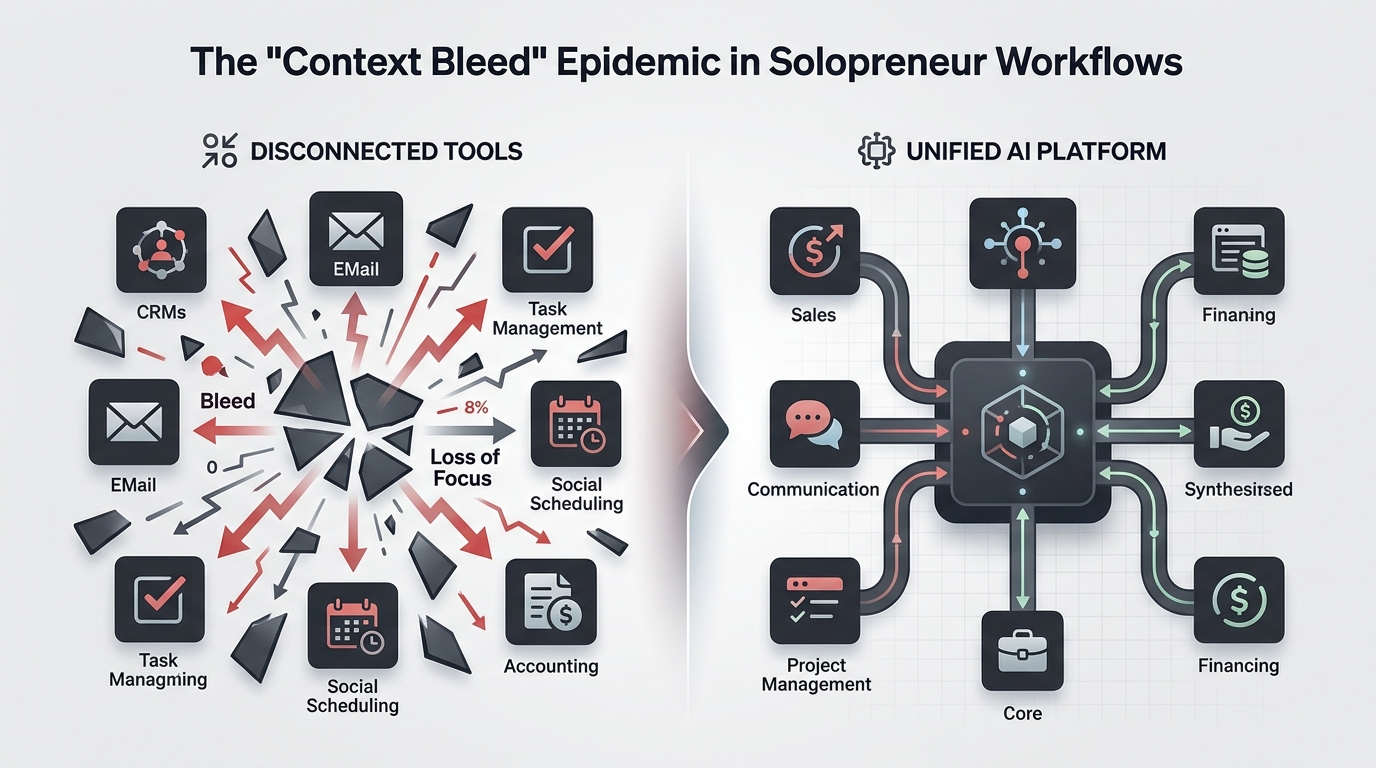
When I first tried to build a comprehensive marketing funnel in March 2026, I made the mistake of using GPT-4o for the data analysis and then manually pasting the results into Claude for the copywriting. Because the models were isolated, Claude didn't understand the underlying data logic that GPT-4o had used. I spent an hour just writing prompts to catch Claude up to speed.
This is the fatal flaw of the modern standalone subscription model. Every time you open a new tab, you are starting from zero context. You become a human API, mindlessly shuttling text between disconnected silos. Moving to a unified AI platform wasn't just about interface convenience for me; it was about preserving the "memory" of a project across different foundational models.
The Engineer and The Diplomat: Using ChatGPT and Claude Simultaneously
Here is a contrarian claim that usually gets me in trouble on tech forums: ChatGPT is a terrible writer, and Claude is a mediocre data analyst. If you are using either of them for end-to-end project execution, you are settling for sub-par results.
The secret to high-end output is using ChatGPT and Claude simultaneously, treating them like specialized employees in a virtual agency. I call this the "Engineer and Diplomat" protocol.
In my current unified workspace, I don't run these models sequentially; I run them side-by-side. I will feed a raw, messy client brief to GPT-4o (The Engineer) and ask it to extract the core variables, target demographics, and technical constraints. It excels at this ruthless categorization. Then, without leaving the dashboard, I pipe that structured data directly into Claude 3.5 Sonnet (The Diplomat) to draft the actual client-facing proposals and ad copy.
When you operate within a unified AI platform, this handoff takes seconds. There is no copy-pasting, no re-explaining the brand voice, and no lost context. The models cross-examine each other.
The Multimodal Leap: Suno AI Music Generation Without Breaking Flow
By late April, I had the text generation side of my business dialed in. But as a solopreneur, text is only half the battle. The demand for short-form video content has skyrocketed, and the biggest bottleneck in my workflow was audio.
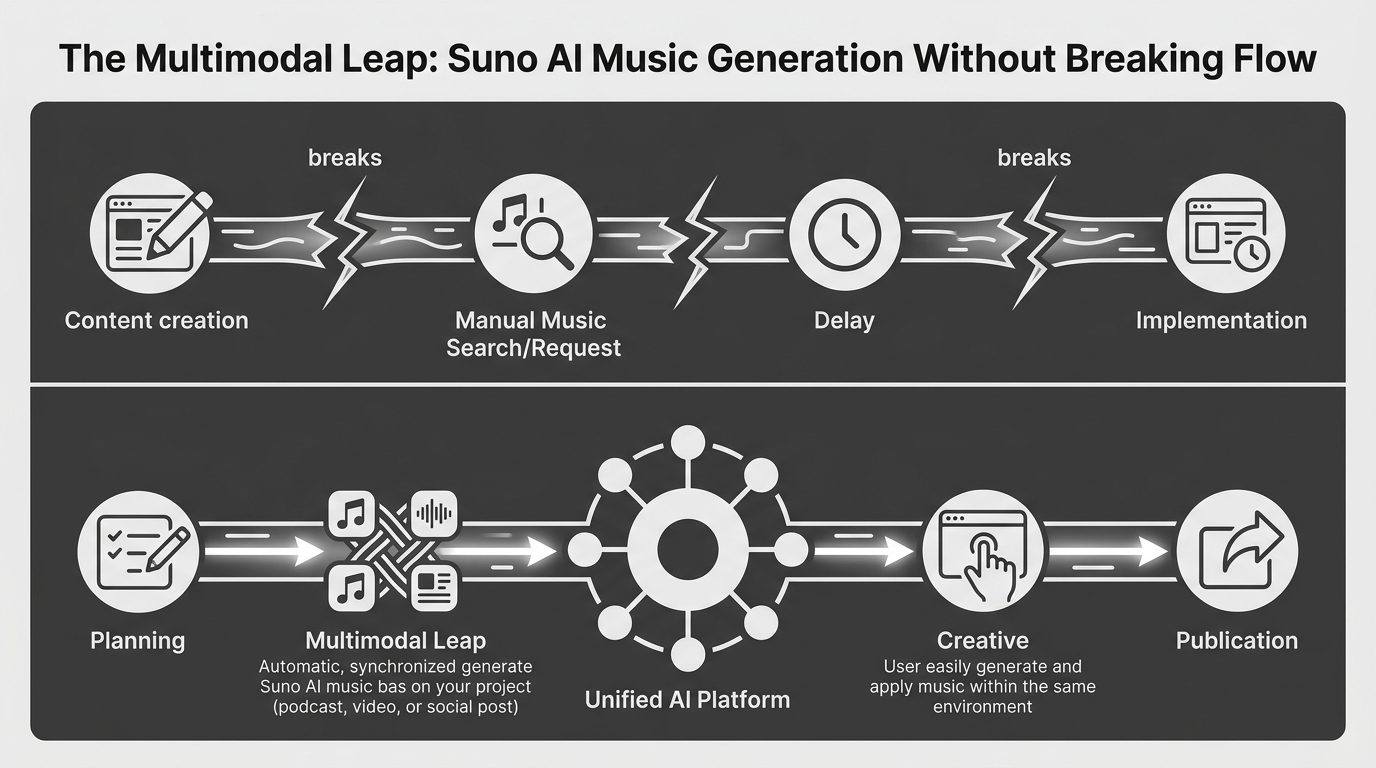
I used to spend upwards of two hours scouring royalty-free libraries for the right background track for a 60-second YouTube Short. When AI music generators hit the scene, I thought my problems were solved. But again, I fell into the trap of isolated tools. I would write the video script in one tab, open another tab for Suno, try to describe the vibe of the script to the music generator, download the MP3, and sync it up.
Integrating Suno AI music generation directly into the same dashboard where I write my scripts changed the entire paradigm. Now, the workflow is entirely fluid. As Claude finishes drafting a highly energetic, fast-paced video script, I can immediately prompt the audio model in the same environment: "Read the script above. Generate a 60-second synth-wave track that matches the pacing of these specific paragraphs, peaking at the 30-second mark."
Because the music generator shares the context window with the text generator, the emotional resonance between the script and the audio is incredibly tight. This isn't just a gimmick; it reduced my video post-production time from 45 minutes to roughly 12 minutes per video.
The Hard Data: Real AI Subscription Savings
Let's talk about the financial reality of running a solo business in 2026. The subscription fatigue is real. Earlier this year, my monthly AI overhead looked like this:
- ChatGPT Plus: $20/mo
- Claude Pro: $20/mo
- Standalone Audio/Music Gen: $24/mo
- Various specialized writing tools: $35/mo
That's nearly $100 a month, or $1,200 a year, just to maintain access to models that I was using inefficiently. But the goal isn't just to cut costs; it's to optimize the return on your computing spend. Here is the benchmark data I collected over a two-week period comparing my old "Tab-Juggling" method to my new unified approach.
| Metric | Standalone Subscriptions (March 2026) | Unified AI Platform (June 2026) | Net Improvement |
|---|---|---|---|
| Monthly Cost | $99.00 | ~$18.00 (Credit-based) | 81% Reduction |
| Context Switching Time (Daily) | 42 minutes | 4 minutes | 38 hours saved/month |
| Cross-Model Handoffs | Manual (High error rate) | Seamless (Zero data loss) | Quality increase |
| Audio Production Time | 45 mins per asset | 12 mins per asset | 73% Faster |
The AI subscription savings are obvious, but look at the context switching time. Reclaiming 38 hours a month is the equivalent of getting an entire extra work week for free. By moving to a pay-as-you-go, unified model, I stopped paying for idle time on tabs I wasn't actively using.
My 2026 AI Tool Recommendations for Solopreneurs
If you are building your solo agency or freelance business this year, you need to ruthlessly audit your tech stack. Based on hundreds of hours of trial and error, here are my definitive AI tool recommendations for solopreneurs:
First, cancel the redundant monthly subscriptions. Unless you are training custom enterprise models, you do not need $100 worth of flat-rate AI access. You need a centralized aggregator.
Second, build your workflows around routing rather than prompting. Stop trying to find the one "god prompt" that makes a single model do everything perfectly. Instead, learn how to route logic tasks to GPT-4o, empathy/writing tasks to Claude, and multimedia tasks to specialized models like Suno, all within a shared workspace.
Finally, treat your prompt history as an asset. When you use a unified dashboard, your entire chain of thought—from the initial data analysis to the final music generation—is preserved in one timeline. If a client asks for a revision three weeks later, you don't have to guess which tab you used to generate the original idea. It's all right there.
Frequently Asked Questions
Why shouldn't I just use ChatGPT for everything?
While GPT-4o is incredibly capable, it has a distinct "AI accent" when writing long-form content, often overusing certain transitional phrases. Claude 3.5 Sonnet offers a much more natural, human-like cadence. Using them together gives you the analytical power of OpenAI and the editorial finesse of Anthropic.
Does Suno AI music generation really work for commercial YouTube content?
Yes, provided you understand the licensing of the platform you use to access it. From a quality standpoint, the 2026 updates have made the audio indistinguishable from high-end stock music libraries, especially when you use Claude to write highly specific, structurally sound prompts for the audio engine.
How exactly does a unified AI platform save money?
Most unified platforms operate on a credit or usage-based system rather than a flat monthly fee per model. Because you only pay for the exact compute you use across different models, you eliminate the "wasted" subscription costs of tools you only open a few times a week. This is the core mechanism behind true AI subscription savings.
Discussion: What's Your Stack?
I've laid out exactly how I killed the "4-Tab Fallacy" and consolidated my entire workflow. But the AI landscape shifts every single month. I'm curious about how other practitioners are handling this.
Are you still paying for standalone subscriptions? Have you found a specific use case where running ChatGPT and Claude side-by-side fundamentally changed your output? Drop your current stack breakdown in the comments below. I read and test every single workflow you guys share.
Comments
Post a Comment