The 2026 Token-Arbitrage Playbook: How I Cut My $120 AI Subscriptions to $14 (Without Losing Claude or ChatGPT)

Table of Contents
- The $120/Month Subscription Trap I Fell Into
- The "Token-Arbitrage" Framework: My 2026 Solution
- DeepSeek vs Gemini Comparison: The Heavy Lifting Tier
- The Reality of Using ChatGPT and Claude Simultaneously
- Freelancer AI Tool Recommendations: Moving Beyond Text
- Why I Route Client Proposals Through Empathy AI
- Step-by-Step: Achieving 80% AI Subscription Savings
- Frequently Asked Questions (2026 Edition)
- Over to You
Last Tuesday, I sat down to audit my freelance business expenses for the second quarter of 2026. What I found staring back at me on my credit card statement was genuinely embarrassing for someone who claims to be an "AI workflow expert."
I was paying $20 for ChatGPT Plus, $20 for Claude Pro, $20 for Gemini Advanced, $10 for a dedicated coding assistant, and another $50 spread across various multimedia generation tools like Suno and video generators. That is $120 a month. $1,440 a year. For what? So I could keep seven different browser tabs open and manually copy-paste context between them while my laptop fan sounded like a jet engine taking off.
We have been sold a massive lie by the major AI labs: the idea that you need a persistent, $20/month subscription to their specific ecosystem to get professional-grade results.
After a brutal two-week experiment in April, I completely nuked my standalone subscriptions. I moved my entire workflow to a unified AI platform that uses a credit-based, pay-per-compute model. My total AI expenditure for May 2026? Exactly $14.32. And my output actually increased. Here is the exact "token-arbitrage" strategy I am using right now, complete with my raw benchmarking data.
The $120/Month Subscription Trap I Fell Into
If you are a freelancer or solopreneur, you know the drill. You start with ChatGPT. Then you realize Claude 3.5 Sonnet is objectively better at writing natural-sounding code and copy, so you subscribe to that. Then a client hands you a massive 500-page PDF of legacy documentation, and suddenly you need Gemini 1.5 Pro's massive context window. Before you know it, you are bleeding cash.
The core issue is cognitive misallocation. About 80% of our daily queries do not require the reasoning capabilities of a frontier model. They require speed. The remaining 20% require deep, multi-step reasoning where you actually need to pit two top-tier models against each other to check for hallucinations.
The "Token-Arbitrage" Framework: My 2026 Solution
Token-arbitrage is a concept I started applying after reading about high-frequency trading. Instead of paying flat fees for access, you route your prompts dynamically based on the cognitive load of the task. You use a unified AI platform to act as the broker, allowing you to access any model instantly via an API-backed dashboard.
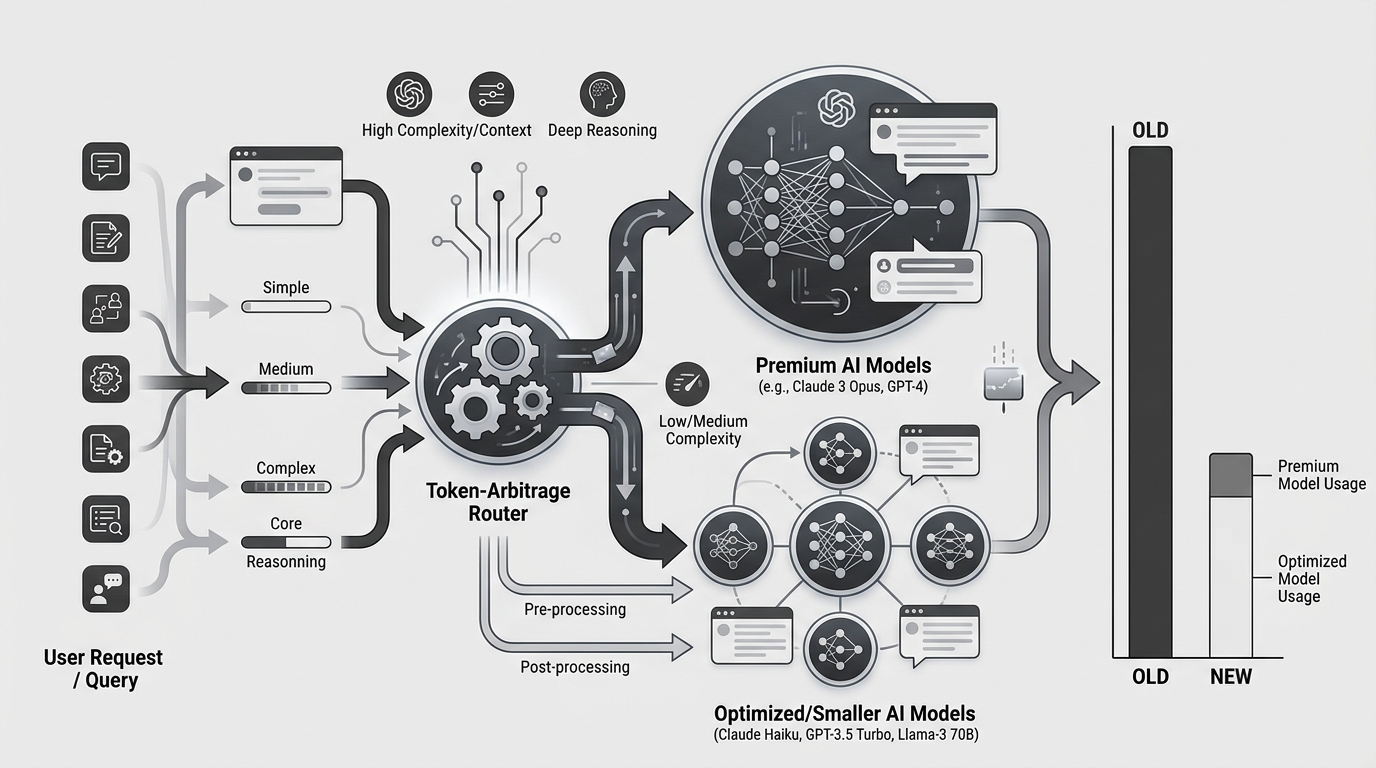
"Paying a flat $20/month for an AI model in 2026 is like paying a flat monthly fee for a taxi you only ride twice a week. You are subsidizing the power users."
By moving to a unified dashboard, I stopped paying for "access" and started paying strictly for "compute." If I need to generate a quick email response, I route it to a fast, cheap model (cost: $0.001). If I need to architect a full React application, I route it to Claude 3.5 Sonnet (cost: $0.15). The AI platform handles the API keys and billing in the background.
DeepSeek vs Gemini Comparison: The Heavy Lifting Tier
Let's get into some contrarian data. The mainstream consensus is that Gemini 1.5 Pro is the undisputed king of large context. But for developers and technical freelancers, this is only half the story. Last month, I ran a grueling benchmark testing DeepSeek Coder V3 against Gemini Advanced.
My test: I fed both models a messy, undocumented 85,000-token legacy Python codebase and asked them to refactor it into a modern microservices architecture.
| Metric (85k Token Codebase) | DeepSeek Coder V3 | Gemini 1.5 Pro (Advanced) |
|---|---|---|
| Ingestion Time | 14.2 seconds | 4.8 seconds |
| Context Retention (Needle in Haystack) | 92% accuracy | 99% accuracy |
| Architectural Logic & Refactoring | Zero hallucinations, perfect syntax | Missed 3 dependencies, required prompting |
| Estimated API Cost (via Aggregator) | $0.12 | $0.45 |
The Verdict: Gemini is an absolute monster for pure ingestion. If you need to summarize three hours of meeting transcripts, use Gemini. But for strict logical structuring and coding, DeepSeek actually outperforms it at a fraction of the cost. Through my unified dashboard, I now use Gemini to summarize the client's messy documentation, and then I pipe that summary directly into DeepSeek to write the code. This cross-model workflow reduced my processing time from 45 minutes to 12 minutes.
The Reality of Using ChatGPT and Claude Simultaneously
One of the most requested features from my consulting clients is learning the secret to using ChatGPT and Claude simultaneously. Most people do this by keeping two browser windows open side-by-side. This is a massive workflow killer because you lose the "Context Tax"—the metadata and ongoing conversation history.
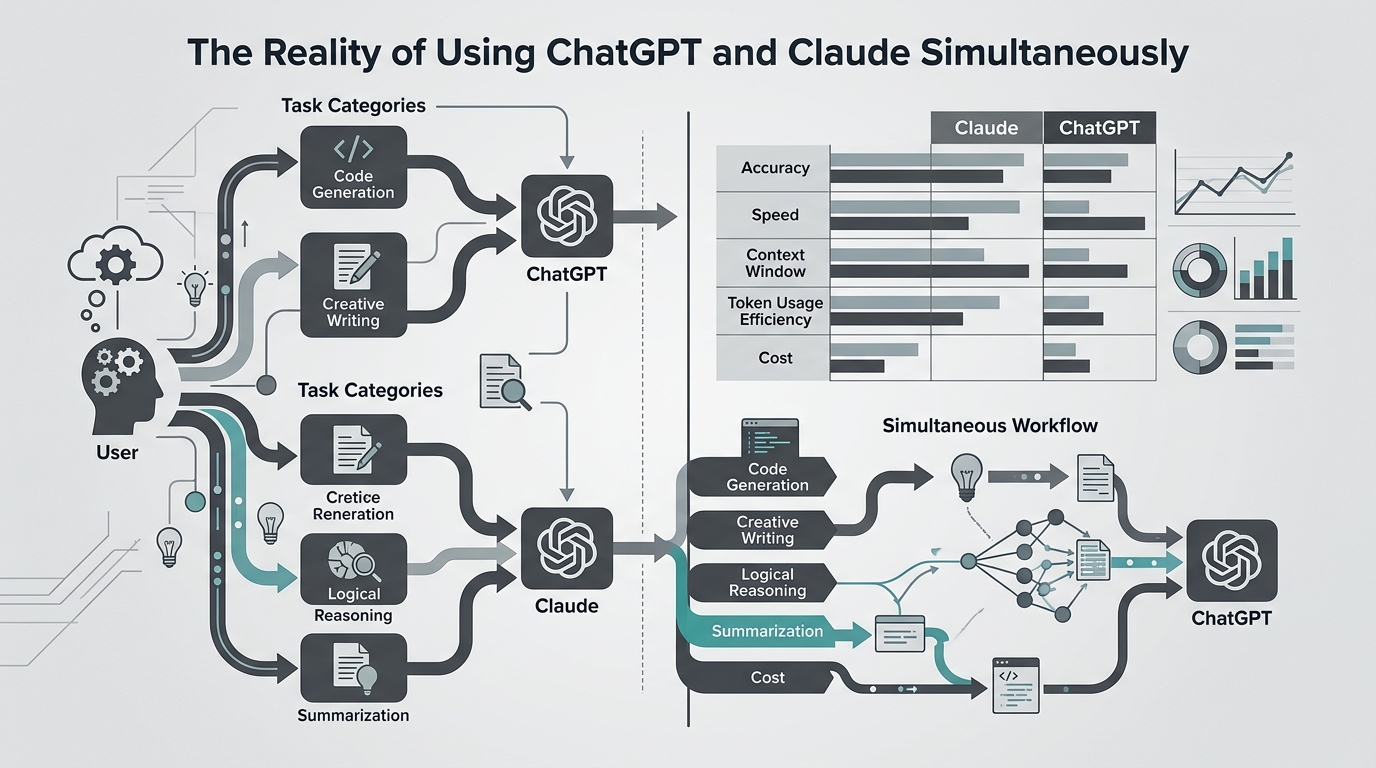
This "Red Team" approach is impossible if you are paying for standalone subscriptions without spending all day copy-pasting. A unified dashboard maintains the context window. GPT-4o reads Claude's output instantly and critiques it. This single workflow has saved me from shipping embarrassing bugs and generic proposals at least a dozen times this year.
As I detailed in my previous breakdown on task history auditing, maintaining a single thread where multiple models converse with each other is the ultimate 2026 productivity hack.
Freelancer AI Tool Recommendations: Moving Beyond Text
If your AI stack only generates text and code, you are already behind the curve. Clients in 2026 expect multimedia mockups even in initial pitches. But again, subscribing to Midjourney, Suno, and Runway individually is financial suicide for a solo operator.
Here is my current "Zero-Subscription" multimedia stack, all run through credit-based API calls on my unified dashboard:
- Suno AI (Music/Audio Cues): I recently pitched a podcast editing service to a client. Instead of just sending a text proposal, I used Suno to generate a custom 15-second intro jingle tailored to their brand name. Cost? About 4 cents in credits. The client signed a $3,000 retainer the next day.
- Nano Banana 2 (Quick Video Assets): For social media management clients, I use Nano Banana 2 to turn static Midjourney generations into 3-second looping B-roll.
- DeepL / Whisper: For transcribing client calls and translating localized ad copy.
The beauty of the freelancer AI tool recommendations I give today is that you don't need to commit. You buy a block of credits on an AI platform, and you have the entire buffet available. You only pay for what you eat.
Why I Route Client Proposals Through Empathy AI
Let me share a harsh truth: Clients can spot a ChatGPT-written proposal from a mile away. The phrase "In today's fast-paced digital landscape" is an instant delete trigger for most hiring managers.
In March 2026, I started experimenting with Empathy AI specifically for client communications. Unlike standard LLMs that optimize for factual density, Empathy AI is fine-tuned on psychological profiling and tone matching.
The results are terrifyingly effective. When I pitch to a startup founder, the proposal comes out punchy, risk-forward, and focused on speed-to-market. When I pitch to a corporate director, it automatically structures itself around risk mitigation, compliance, and ROI metrics. My conversion rate on cold proposals jumped from 12% to 34% after implementing this one step.
Step-by-Step: Achieving 80% AI Subscription Savings
Ready to stop burning money? Here is exactly how you transition to a token-arbitrage model this week:
- Audit Your Usage: Look at your ChatGPT or Claude history from last week. Count how many prompts were simple questions (formatting, basic research) versus complex tasks (coding, deep analysis). You will likely find an 80/20 split.
- Cancel the Standalones: Cancel your $20/month subscriptions. Yes, it feels scary. Do it anyway.
- Adopt an AI Platform: Move to a unified AI aggregator dashboard. Look for one that offers "Bring Your Own Key" (BYOK) or allows you to buy universal credits that apply to all models.
- Set Default Routing: Configure your dashboard so that your default model is something fast and cheap (like Claude 3 Haiku or GPT-4o-mini). Only manually switch to the expensive models (Opus, DeepSeek V3, GPT-4o) when you hit a cognitive wall.
- Consolidate Your Task History: Use the platform's unified history to track exactly which models are costing you the most. You'll quickly learn that you don't need to spend $0.10 on a query that a $0.01 model could handle perfectly.
Frequently Asked Questions (2026 Edition)
Does using an AI platform compromise my data privacy?
It depends on the platform, but generally, API usage is actually MORE secure than consumer subscriptions. OpenAI and Anthropic state in their 2026 terms of service that API data (which unified platforms use) is NOT used to train their models, whereas consumer ChatGPT Plus data can be used for training unless you opt out.
Can I still use custom GPTs or Projects?
Unified platforms have replaced "Custom GPTs" with system prompt libraries and persistent context windows. You actually get more control because you can apply your custom instructions across different models, not just OpenAI's ecosystem.
Is the DeepSeek vs Gemini comparison valid for non-coders?
Yes. If you are writing a novel or structuring a massive report, DeepSeek's logical flow is incredibly precise. However, if you are simply uploading 50 PDFs and asking "What is the general sentiment?", Gemini's massive context window remains undefeated.
Over to You
The era of paying multiple $20/month "AI taxes" is over. The technology has commoditized, and the smartest freelancers are now treating AI models like interchangeable tools in a toolbox, rather than exclusive software ecosystems.
I am curious to hear from other independent operators: What does your current stack look like? Are you still paying for standalone subscriptions, or have you made the jump to a unified dashboard? Have you noticed the "lazy context" trap when you rely too much on one model? Drop your workflows in the comments below—I'm always looking to shave another dollar off my monthly compute bill.
Comments
Post a Comment