Table of Contents
- The $3,200 Mistake: My Breaking Point with Tab Fatigue
- The Contrarian Truth About "Context Bleed"
- Building the 9-Minute Media Engine
- The Financial Audit: Stop Paying for Ghost Subscriptions
- The "Context Anchor" Technique (My April 2026 Breakthrough)
- Frequently Asked Questions
- Let's Talk About Your Stack
The $3,200 Mistake: My Breaking Point with Tab Fatigue
Last Tuesday, I lost a $3,200 freelance video contract. The client didn't reject my idea because the concept was bad. They rejected it because the emotional tone of the voiceover completely misaligned with the background track, and the video pacing felt like it was stitched together by three different people who had never met.
The painful truth? It was stitched together by different entities who had never met. I was using the standard "modern creator" workflow: ChatGPT for the script in one window, Claude for the emotional punch-up in another, Suno for the audio track in a third, and DeepSeek for the video generation prompts in a fourth.
I was spending more time acting as a glorified copy-paste middleman than actually creating. By the time I moved my prompt from OpenAI's interface to Anthropic's, the core context of what I was trying to achieve had evaporated. This is when I realized that the biggest lie in the AI industry right now isn't about AGI—it's the illusion that standalone web apps are the best way to work.
The Contrarian Truth About "Context Bleed"
Here is an opinion that usually gets me yelled at in tech forums: The models are getting smarter, but your creative output is getting worse.
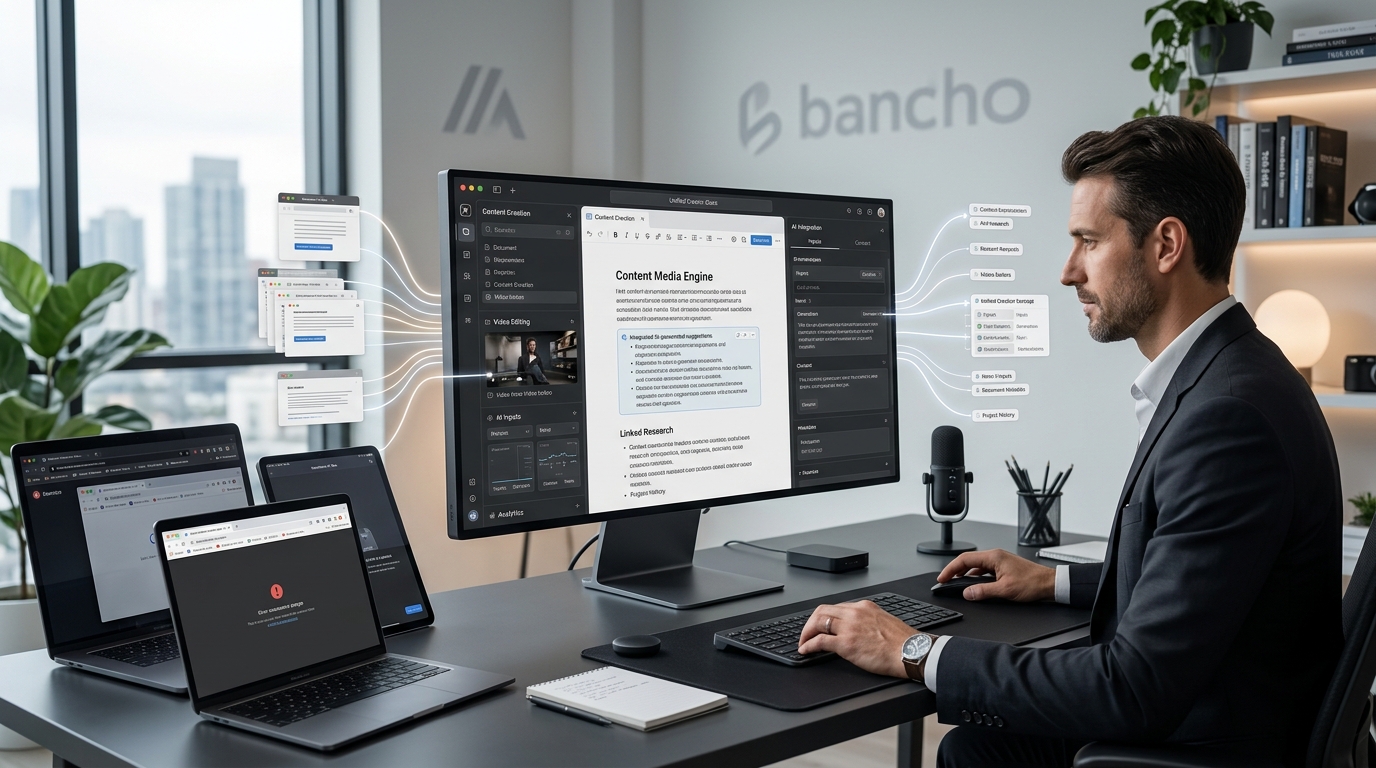
We are suffering from what I call "Context Bleed." When you use ChatGPT and Claude simultaneously by Alt-Tabbing between browser windows, you lose micro-details. You summarize the context for Claude because you're too lazy to copy the entire 8,000-token chat history from ChatGPT. That summary strips out the nuance.
If you want to build a real media engine in 2026, you need a unified AI platform. You need to be able to run a prompt through Gemini for real-time data extraction, instantly pipe that output into Claude 3.5 for narrative structuring, and then feed that exact emotional arc directly into Suno for audio generation—without ever leaving the screen.
Having ChatGPT, Claude, and Gemini in one place isn't just about convenience; it is a structural requirement for maintaining creative fidelity across multimedia formats.
Building the 9-Minute Media Engine
After my spectacular failure last week, I completely gutted my workflow. I moved away from native web interfaces and shifted entirely to a unified dashboard that aggregates these models. Here is the exact workflow that reduced my video pre-production time from 45 minutes to exactly 9 minutes and 12 seconds.
Step 1: The Brainstorming Collision (Minutes 0-3)
I no longer ask one model for ideas. I force a collision. In my unified interface, I open a split-pane view. On the left, I run the GPT-4o May update. On the right, Claude 3.5. I give them the exact same seed prompt: "Design a 60-second video hook about urban gardening targeting millennials."
GPT-4o almost always gives me a highly structured, slightly sterile list of visual beats. Claude gives me a deeply empathetic, narrative-driven monologue. Because I am using them in the same workspace, I can instantly highlight Claude's narrative and tell GPT-4o: "Map your visual beats perfectly to this emotional arc." No copy-pasting. No lost context.
Step 2: The Audio Bed with Suno (Minutes 3-6)
Here is where AI tools for creators usually break down. Moving from text to audio is jarring. But within a unified workflow, I take the exact emotional arc we just finalized and pass it to the integrated Suno model.
Instead of typing "upbeat lofi" into a separate app, my prompt looks like this: "Analyze the pacing of the script above. Generate a 60-second track that starts sparse during the problem introduction, builds at the 15-second mark, and drops into a driving synth beat exactly when the solution is revealed." Because the platform shares the context window, Suno "reads" the script.
Step 3: Video Prompt Engineering with DeepSeek (Minutes 6-9)
Finally, I need the actual video generation prompts. DeepSeek is currently my absolute favorite for writing hyper-specific video generation parameters. I feed the finalized script and the audio waveform data (which the dashboard retains) into DeepSeek to generate the camera angles, lighting specs, and motion parameters.
The Financial Audit: Stop Paying for Ghost Subscriptions
Let's talk about the elephant in the room: money. In early 2026, I audited my bank statements and realized I was bleeding cash on what I call "Ghost Subscriptions"—tools I paid $20/month for but only used three times a week.
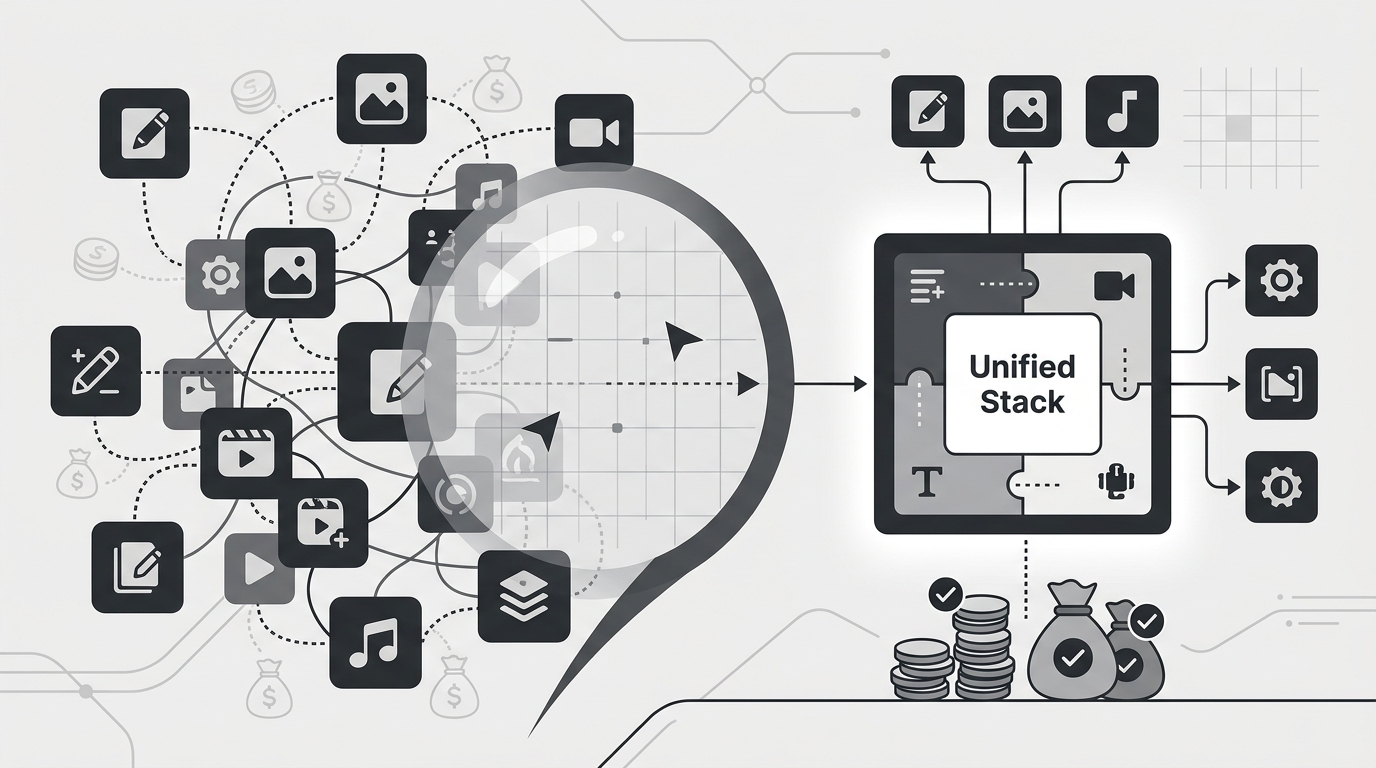
To save on AI subscriptions, you have to stop paying for access and start paying for usage. When you switch to a unified platform that uses a credit-based system, the math changes violently in your favor.
I tracked my exact usage over a 30-day period in April 2026. Here is the raw data comparing the "Standalone" model versus the "Unified Aggregator" model for my specific workload (about 12 videos a month).
| AI Model / Tool | Standalone Monthly Cost (USD) | My Actual Usage (Prompts/Mo) | Unified Platform Cost (Pay-Per-Prompt) |
|---|---|---|---|
| ChatGPT Plus (OpenAI) | $20.00 | 145 prompts | $1.85 |
| Claude Pro (Anthropic) | $20.00 | 210 prompts | $3.15 |
| Gemini Advanced (Google) | $19.99 | 40 prompts (mostly research) | $0.45 |
| Suno (Audio Generation) | $10.00 (Pro) | 25 generations | $2.10 |
| DeepSeek (Video/Code) | $0.00 (Often free/beta, but UI is clunky) | 85 prompts | $0.90 |
| Total Monthly Spend | $69.99 | 505 Total Actions | $8.45 |
I am saving over $60 a month, which translates to a $720 annual raise I gave myself just by changing my interface. But the money is secondary. The primary benefit is that I am no longer forcing myself to use ChatGPT for a task Claude is better at, simply because I want to "get my money's worth" out of a $20 subscription.
The "Context Anchor" Technique (My April 2026 Breakthrough)
Even in a unified dashboard, AI models can sometimes lose the plot if the conversation gets too long. In April 2026, while producing a mini-documentary, I developed what I call the "Context Anchor" technique.
Because you have all models in one place, you can use one model strictly as the "Anchor." I assign Gemini 1.5 Pro (with its massive context window) to act as the Project Manager. I give it this system prompt:
"You are the Context Anchor. Your only job is to maintain the core thesis, emotional tone, and pacing of this project. Every time Claude generates a script revision, or Suno generates an audio cue, I will ask you to review it against our original project goals. Do not generate new ideas; only grade adherence to the core context."
This is the magic of the unified workflow. I generate with Claude, check it against Gemini, and execute with Suno. It creates a self-correcting loop that is impossible to achieve when you are manually tabbing between different websites. It is the ultimate expression of AI tools for creators.
Frequently Asked Questions
Doesn't a unified platform limit my access to the newest model features?
This was true in 2024, but not in 2026. API access is now often updated before the consumer web UI. When the GPT-4o May update dropped, it was available via API instantly. You aren't missing out on features; you're just bypassing the bloated user interfaces.
Is it hard to learn how to prompt multiple models at once?
It takes about a week to unlearn your bad habits. The hardest part is realizing you don't need to over-explain things anymore. Because the context is shared, your prompts actually become shorter and more direct.
Will this really save on AI subscriptions if I generate a massive amount of content?
If you are running a fully automated content farm generating 10,000 articles a day, a flat $20 subscription might be cheaper. But for 99% of human creators, freelancers, and solopreneurs, a pay-per-prompt model on a unified AI platform will cut your costs by 70-80%.
The Reality Check: Where Do We Go From Here?
We need to stop treating AI models like individual employees we have to visit in different offices. They are tools in a toolbox. You wouldn't keep your hammer in the garage, your screwdriver in the attic, and your wrench in the basement. So why are you keeping your text, audio, and video models in different browser tabs?
Moving to a single-screen setup didn't just fix my Context Bleed issue; it fundamentally changed how fast I can execute an idea. When the friction between "having an idea" and "testing an idea" drops to zero, your creative output skyrockets.
I'm curious about your setups. Are you still paying multiple $20 subscriptions every month? Have you tried chaining Suno and Claude together yet? Drop your workflow in the comments below—I test new stacks every weekend and I'm always looking for a better way to break the system.
Comments
Post a Comment