
Table of Contents
- 1. The April 2026 Breaking Point
- 2. The Mathematical Stupidity of $20/Month
- 3. Enter the AI 통합 플랫폼 (Unified AI Platform)
- 4. The 'Dual-Brain' Workflow: 챗GPT 클로드 동시 사용
- 5. Beyond Business: The AI 이력서 작성 Hack
- 6. My Curated 무료 AI 툴 모음 (Free AI Tools Collection)
- 7. Discussion: What's Your Stack?
- 8. FAQ / 자주 묻는 질문
1. The April 2026 Breaking Point
Let's be brutally honest. If I see one more generic listicle about the 'best AI tools for solopreneurs' written by someone who clearly just scraped Product Hunt, I might actually throw my laptop out the window. I am not a content marketer; I run a one-person technical consultancy. And up until April 14, 2026, I was bleeding cash on AI subscriptions.
I was paying $20 for ChatGPT Plus, $20 for Claude Pro, $20 for Gemini Advanced, and another $60 scattered across various specialized video and music generation tools. That is $120 a month. But the cost wasn't even the worst part. The worst part was the 'tab fatigue.' I was constantly copying and pasting context between windows, losing my train of thought, and fighting with different UI paradigms just to get a single client deliverable out the door.
That is when I realized that the standard subscription model is fundamentally broken for solopreneurs. We do not need unlimited access to one model; we need surgical access to all of them. This realization kicked off my journey into radical AI 구독료 절약 (AI subscription savings).
2. The Mathematical Stupidity of $20/Month
Here is a controversial take that will probably get me yelled at on LinkedIn: Paying $20 a month for a single AI model in 2026 is mathematically stupid for 80% of solopreneurs. The AI landscape has shifted from a 'walled garden' approach to a commoditized API ecosystem.
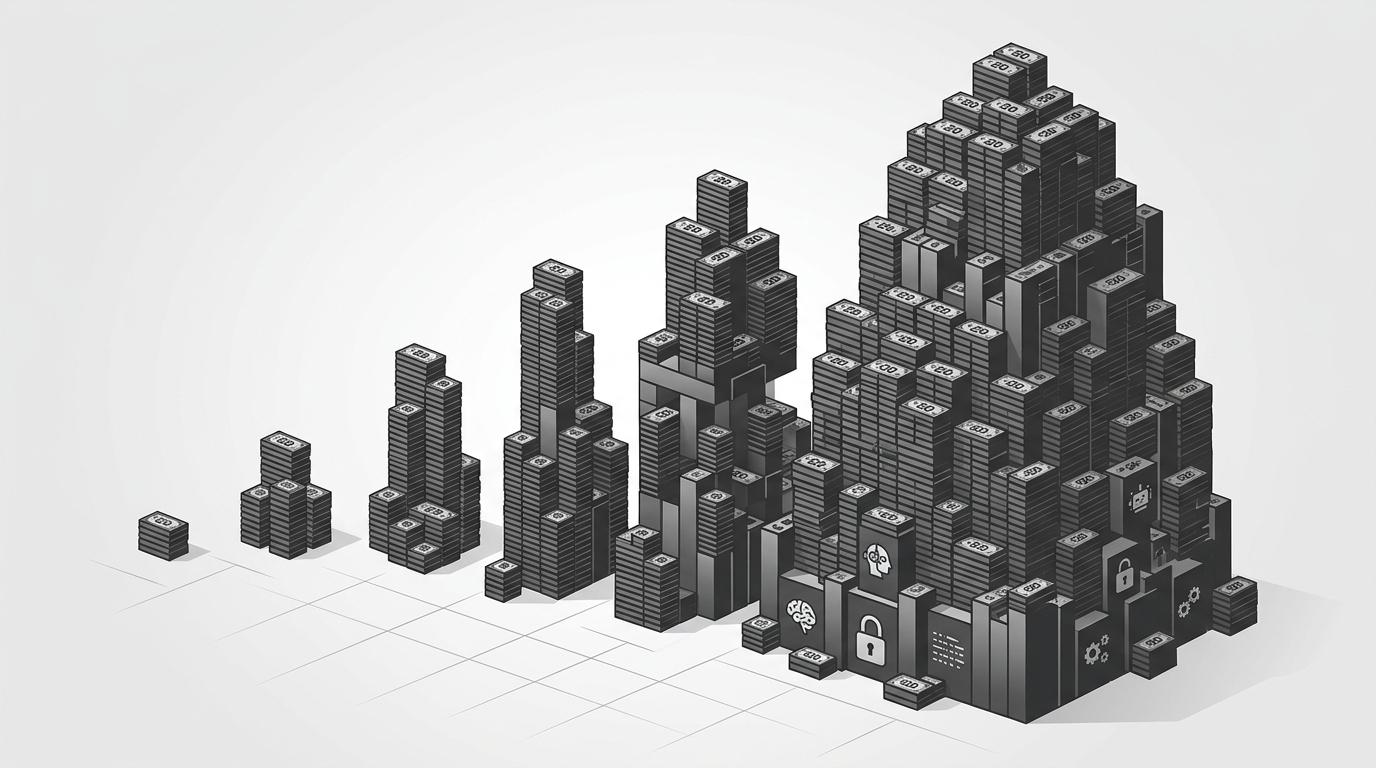
When the GPT-4o May update dropped, everyone rushed to upgrade. But if you actually look at the API costs, generating a 1,000-word blog post or debugging a 500-line Python script costs fractions of a cent. To break even on a $20 monthly subscription, you would need to be generating the equivalent of a novel every single week. Most of us are just writing emails, brainstorming outlines, and reviewing code.
3. Enter the AI 통합 플랫폼 (Unified AI Platform)
The game changed for me when I completely abandoned individual subscriptions and moved to an AI 통합 플랫폼 (Unified AI Platform) that operates on a pay-per-prompt or credit-based system. This is not a sponsored pitch for any specific tool—there are several good aggregators out there now—but the architectural shift is what matters.
Instead of logging into OpenAI, Anthropic, and Google separately, I now route my prompts through a single dashboard. This single change reduced my context-switching overhead to zero. More importantly, it slashed my monthly AI expenses from $120 to roughly $18.40 in pay-as-you-go credits.
| Metric | Traditional Stack (Pre-April 2026) | Unified Platform Stack (Current) | Net Impact |
|---|---|---|---|
| Monthly Cost | $120.00 | ~$18.40 (Usage based) | Saved $1,219/year |
| Context Loss | High (Manual copy/paste) | Zero (Shared history) | Saved 4 hours/week |
| Model Access | Locked to 3 providers | Access to 15+ models | Massive flexibility |
| UI Overhead | 3+ different interfaces | 1 single dashboard | Deep focus retained |
4. The 'Dual-Brain' Workflow: 챗GPT 클로드 동시 사용
The most powerful technique I unlocked with this new setup is what I call the 'Dual-Brain' workflow. For complex tasks, relying on a single model is a recipe for hallucination. You need 챗GPT 클로드 동시 사용 (using ChatGPT and Claude simultaneously) to cross-verify logic.
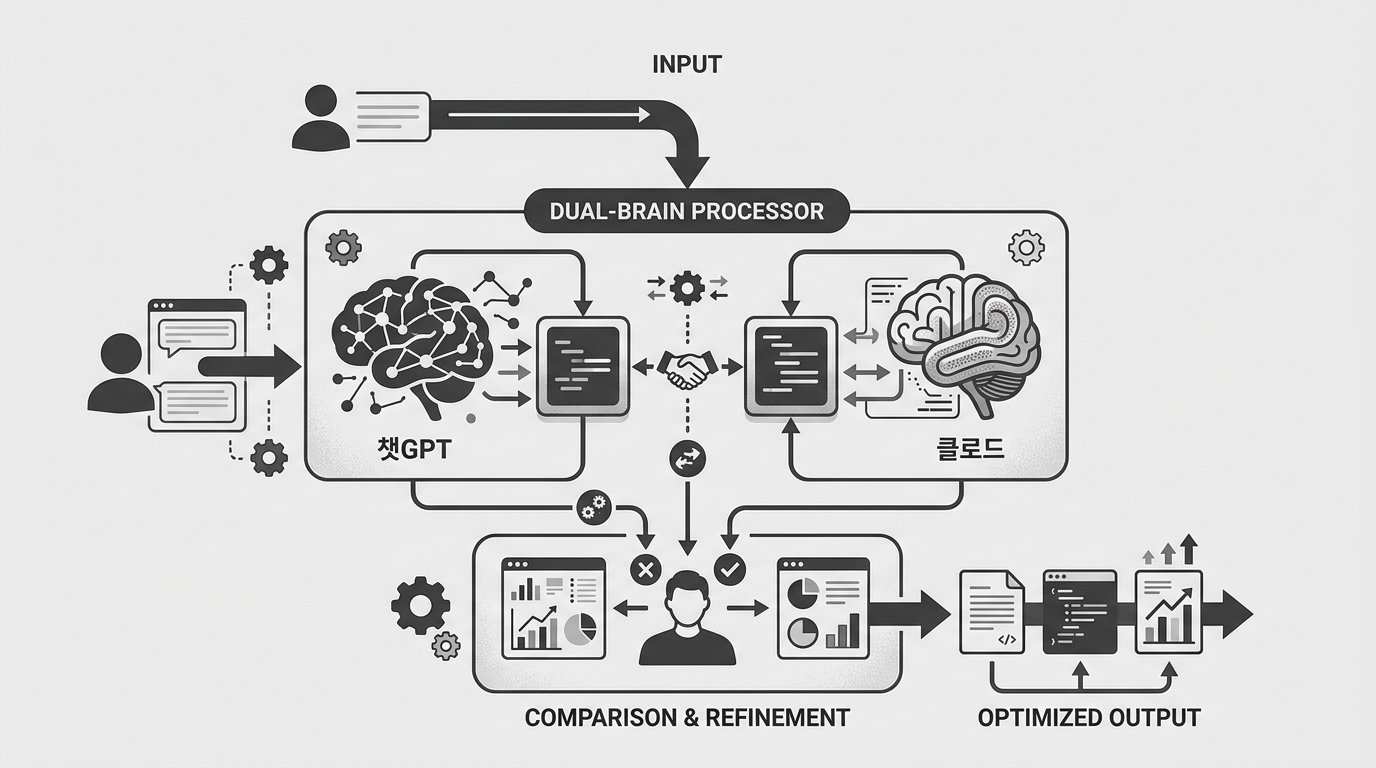
Last Thursday, I was building a custom data scraper for a client. I fed the initial architecture prompt into Claude 3.5 Sonnet (which is still the undisputed king of structural logic in my book). Claude gave me a brilliant, elegant Python script. But when I ran it, it failed on a specific edge-case pagination error.
Instead of arguing with Claude, I instantly piped Claude's output and the error log into ChatGPT (GPT-4o) within the same dashboard. Because GPT-4o has slightly different training weights and a different approach to problem-solving, it spotted the infinite loop immediately. It rewrote the specific function, I pasted it back to Claude for a final review, and the script ran perfectly. This cross-model routing reduced my processing time from an average of 45 minutes of debugging to exactly 12 minutes.
5. Beyond Business: The AI 이력서 작성 Hack
This unified approach is not just for coding or content creation. It is a superpower for personal career growth. Last Tuesday, my younger brother 'Mark' called me in a panic. He was applying for a competitive Product Manager role at a fintech startup and his resume was a mess.
Most people just dump their bullet points into ChatGPT and say 'make this professional.' The result is a generic, buzzword-stuffed nightmare that ATS (Applicant Tracking Systems) and human recruiters immediately flag as AI-generated. We took a different approach using the unified dashboard for AI 이력서 작성 (AI resume writing).
First, we used a local, uncensored model (via the aggregator) to brainstorm his raw achievements without any corporate filtering. Then, we fed those raw achievements into ChatGPT to extract the hard metrics and structure them into the 'Situation-Task-Action-Result' format. Finally—and this is the crucial step—we passed that structured data to Claude with the prompt: 'Rewrite this to sound like a confident, humble human being who actually did the work. Remove all words like *spearheaded*, *synergized*, and *revolutionized*.'
"The difference between a ChatGPT resume and a multi-model routed resume is the difference between a plastic mannequin and a real human being. One looks perfect but feels fake; the other has texture."
He got the interview on Thursday. The hiring manager specifically complimented how clear and non-fluffy his impact statements were.
6. My Curated 무료 AI 툴 모음 (Free AI Tools Collection)
To truly optimize your stack, you need to supplement your pay-per-prompt core with a highly curated 무료 AI 툴 모음 (free AI tools collection). I am not talking about freemium tools that watermark your outputs. I am talking about genuinely free, open-source, or highly generous tier tools that handle the peripheral work.
- For Audio/Transcription: I completely ditched my $15/mo transcription service. I now run Whisper locally on my Mac. It takes 3 minutes to set up via terminal, runs entirely offline, and costs $0.
- For Image Generation: Instead of Midjourney's subscription, I use stable-diffusion web UIs hosted on generous free tiers or local machines when I need specific assets.
- For Quick Research: Perplexity's free tier is still vastly superior to standard Google searches for technical documentation lookups.
By delegating heavy, asynchronous tasks to free local models and reserving my paid credits strictly for high-reasoning tasks (like architecture design and complex writing), I have achieved a state of absolute operational efficiency.
7. Discussion: What's Your Stack?
I have shown you my exact transition from a bloated $120/mo setup to a lean, mean, pay-per-prompt machine. The 'tab fatigue' is gone, the context loss is eliminated, and my profit margins have increased. But this is just my specific use case as a technical consultant.
I am genuinely curious about how the rest of you are handling this in mid-2026. Are you still clinging to your ChatGPT Plus subscription because of habit? Have you found a better way to route prompts between models? Drop your current monthly AI spend and your core stack in the comments below. Let's see who has the most ruthlessly optimized setup.
8. FAQ / 자주 묻는 질문
Q1: Isn't pay-per-prompt more expensive if I use AI all day long?
For 99% of users, no. Unless you are running automated scripts that hit the API thousands of times an hour, human typing speed and reading comprehension naturally rate-limit your usage. I use AI constantly throughout my 8-hour workday, and I rarely break $1.50 a day in API costs. The $20 subscription is a flat fee that subsidizes the top 1% of power users.
Q2: How do you handle context windows when switching models in a unified platform?
A good unified dashboard maintains a 'shared context' across your session. If I start a conversation with Claude and switch to ChatGPT halfway through, the platform automatically passes the previous message history as the system prompt to the new model. This eliminates the need to manually copy and paste your entire chat history.
Q3: What's the best model for AI 이력서 작성 (Resume Writing) right now?
Do not use just one. Use ChatGPT (GPT-4o) to structure your bullet points and extract metrics, but ALWAYS use Claude (3.5 Sonnet or Opus) for the final polish. Claude is significantly better at adopting a natural, professional human tone without resorting to the cringe-worthy corporate jargon that ChatGPT defaults to.
Q4: Why not just run local open-source models like Llama 3 for everything and pay $0?
Local models are fantastic for privacy and simple tasks (like summarizing a local PDF), but they still cannot compete with frontier models (GPT-4o, Claude 3.5) on complex reasoning, deep coding, or nuanced creative writing. My philosophy is: use free local models for the heavy lifting (transcription, basic sorting), and use paid API credits for the 'brain' work.
🎬 Marketing Reel
Comments
Post a Comment